
JWT vs Session Authentication: Which Should You Use?
Compare JWT vs session authentication, including security, scalability, revocation, storage, and the best choice for web applications and APIs.
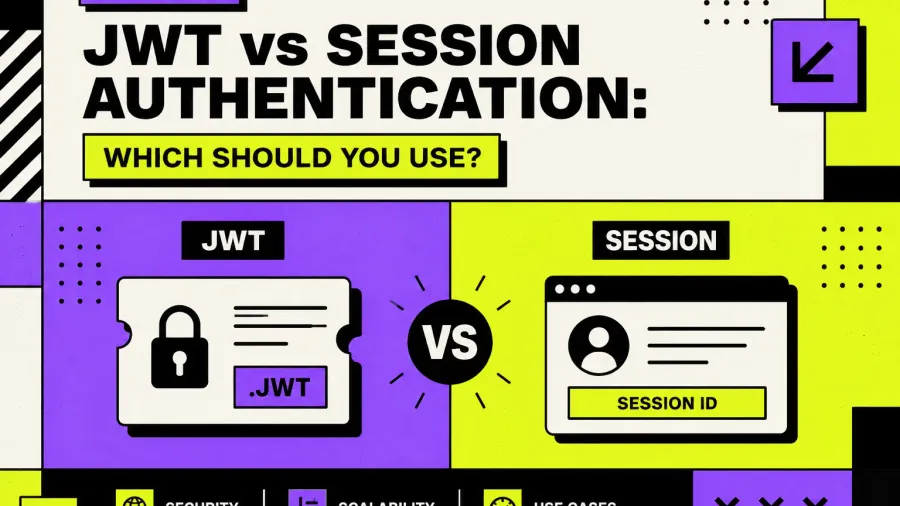
JWT vs session authentication usually comes down to one architectural question: where should authentication state live?
With sessions, the server stores authentication state and the browser holds an opaque session ID. With JWT authentication, the client holds a signed token containing claims that the server can verify without looking up a session in a database.
Neither approach is automatically more secure or more scalable. The right choice depends on your application.
JWT vs Session Authentication Quick Comparison
| Feature | JWT Authentication | Session Authentication |
|---|---|---|
| Server-side auth state | Usually not required | Required |
| Client credential | Signed token | Random session ID |
| Immediate revocation | More complex | Simple |
| Credential size | Larger | Small |
| Horizontal scaling | Convenient | Requires shared/sticky session strategy |
| Contains readable claims | Usually yes | No |
| Best fit | Distributed APIs and services | Traditional web applications |
Use sessions by default for a conventional server-rendered web application. Use JWTs when stateless token verification provides a concrete architectural benefit, such as authentication across multiple APIs or independently deployed services.
How Session Authentication Works
A typical session login workflow follows these steps:
1. POST /login with credentials
2. Server validates credentials
3. Server creates session:
   "abc123" -> { userId: 42, role: "admin" }
4. Browser receives:
   Set-Cookie: session=abc123; HttpOnly; Secure; SameSite=Lax
5. Browser sends the cookie on later requests
6. Server loads session "abc123"
The browser does not need to know the user’s ID or permissions. It only stores an opaque identifier.
Because the server controls the session record, logout and revocation are straightforward:
DELETE session["abc123"]The session ID immediately stops resolving to an authenticated session.
The tradeoff is infrastructure. If requests hit multiple application servers, those servers need access to shared session data (like Redis or PostgreSQL) or a sticky session routing strategy.
How JWT Authentication Works
A JSON Web Token is a compact claims format standardized by RFC 7519.
A JWT commonly contains payload claims similar to:
{
  "sub": "42",
  "role": "admin",
  "iat": 1786060800,
  "exp": 1786061700
}
The server signs the token. Later, another service can validate its signature and claims without retrieving a traditional server-side session.
You can safely inspect the structure and expiration claims of a token with CodAI’s JWT Decoder. The tool runs 100% locally in your browser, so JWT payloads are never sent to a remote service.
One critical detail: JWT payloads are encoded, not encrypted by default. Anyone holding a typical signed JWT can decode its claims. Never treat the payload as a place to hide passwords, secrets, or sensitive private data.
JWT vs Session Authentication Security
JWTs are not inherently safer than sessions.
If an attacker steals a valid session ID, they may impersonate its owner. If an attacker steals a valid bearer JWT, the same basic problem applies.
The important security decisions include:
- Enforcing HTTPS encryption;
- Protecting credentials from script access where appropriate;
- Setting secure cookie attributes (
HttpOnly,Secure,SameSite=Lax); - Limiting token or session lifetime;
- Validating authentication data correctly;
- Handling logout and credential revocation.
For browser applications, storing bearer tokens in JavaScript-accessible storage (localStorage) introduces exposure if malicious JavaScript executes in the page. HttpOnly cookies prevent JavaScript from directly reading the cookie, although cookie-based authentication also requires appropriate CSRF defenses.
See MDN’s secure cookie configuration guidance when configuring authentication cookies.
The Revocation Difference Matters
Revocation is one of the strongest practical arguments for sessions.
Suppose an employee account is disabled at 14:00. With server-side sessions, you can delete that user’s active sessions immediately.
A self-contained JWT may remain cryptographically valid until its expiration time unless your architecture adds a revocation check, denylist, token-version check, or similar mechanism.
That does not make JWTs unusable. It means long-lived access tokens deserve careful scrutiny. Short-lived access tokens combined with a controlled refresh mechanism are generally easier to manage than issuing one bearer token that remains valid for days.
When debugging expiration problems, the Unix Timestamp Converter can convert JWT iat, nbf, and exp timestamps into readable dates.
When Should You Use Sessions?
Sessions are a strong default when your application has a conventional browser-to-backend architecture.
Choose sessions when:
- your backend already maintains shared state;
- immediate logout or revocation is important;
- you want small opaque browser credentials;
- authentication primarily targets your own web frontend;
- you do not need multiple independent services to validate credentials without a shared lookup.
A database or centralized cache can make sessions available across multiple application instances. Scaling horizontally therefore does not require replacing sessions with JWTs.
When Should You Use JWT Authentication?
JWT authentication makes more sense when multiple systems need to validate signed claims independently.
Typical cases include:
- APIs consumed by different third-party clients;
- distributed microservices with appropriate trust boundaries;
- identity systems issuing short-lived access tokens;
- architectures where avoiding a session lookup is valuable.
Do not choose JWT merely because an application is a SPA or because JWTs are described as “stateless.” Your application may still need state for refresh tokens, account revocation, authorization changes, rate limits, or security events.
For other local debugging utilities, see CodAI Developer Tools and the JSON Formatter & Validator.
Common JWT and Session Mistakes
- Putting secrets inside JWT payloads: Signed JWT claims are readable by the token holder. A signature protects integrity; it does not provide confidentiality.
- Using extremely long JWT lifetimes: A stolen bearer token remains useful until expiration when no effective revocation mechanism exists.
- Assuming sessions cannot scale: Sessions can be stored in infrastructure shared across application instances (Redis, Memcached, PostgreSQL).
- Ignoring cookie configuration: Authentication cookies should use appropriate
HttpOnly,Secure, andSameSiteattributes for the application’s deployment model. - Treating authentication as authorization: Proving who sent a request does not prove that user can perform every requested operation.
JWT vs Session Authentication FAQs
Is JWT better than session authentication?
No. JWT is better when independently verifiable signed tokens solve an architectural requirement. Sessions are often simpler for conventional web applications.
Are JWTs more secure than sessions?
Not inherently. Both approaches depend on secure credential storage, transport, expiration, validation, and revocation strategies.
Can JWTs be revoked?
Yes, but immediate revocation usually requires additional state or checks, such as a denylist or token-version mechanism. That removes some of the simplicity expected from completely stateless verification.
Are sessions bad for microservices?
Not automatically. The correct authentication design depends on service boundaries and infrastructure. JWTs can reduce centralized authentication lookups, but token expiration, key management, authorization changes, and revocation still require deliberate design.
Should JWTs be stored in localStorage?
Avoid assuming localStorage is the default location for sensitive bearer credentials. JavaScript running in the same origin can access it. Evaluate secure HttpOnly cookies and your application’s CSRF/XSS threat model before choosing browser token storage.
Conclusion
For most conventional web apps, start with server-side sessions unless you have a specific reason to use self-contained tokens. If distributed APIs need independently verifiable claims, JWTs can be the better fit—provided token lifetime, storage, signing, and revocation are designed explicitly.

Lucky Yaduvanshi
Computer Science Student & Creator of CodAI. Passionate about 100% offline local AI software tools.