Privacy first. Really.
CodAI exists so that software engineers, students, and teams can use an AI assistant without sending a single byte of their code to anyone.
- current release
- v3.0.0
- license, forever
- GPL-3.0
- minimum RAM
- 2 GB
- telemetry scripts
- 0
Born during university lab exams.
CodAI started with a simple frustration: during university lab exams and coding competitions — exactly when students need help most — cloud AI assistants are useless, because lab machines have no internet access.
As a computer science student, I kept hitting the same wall. Restricted networks, no sign-ins allowed, and tools like ChatGPT or GitHub Copilot simply won’t run. Students were left debugging complex algorithms with nothing but documentation.
So the question became: what would it take to run a real coding assistant entirely on the student’s own machine?Quantized models small enough for 2 GB of RAM, a local runtime, a desktop app that fits on a USB stick — and no account anywhere in the flow.
That’s what CodAI is now. It’s free, it’s GPL-3.0, and it will stay that way.
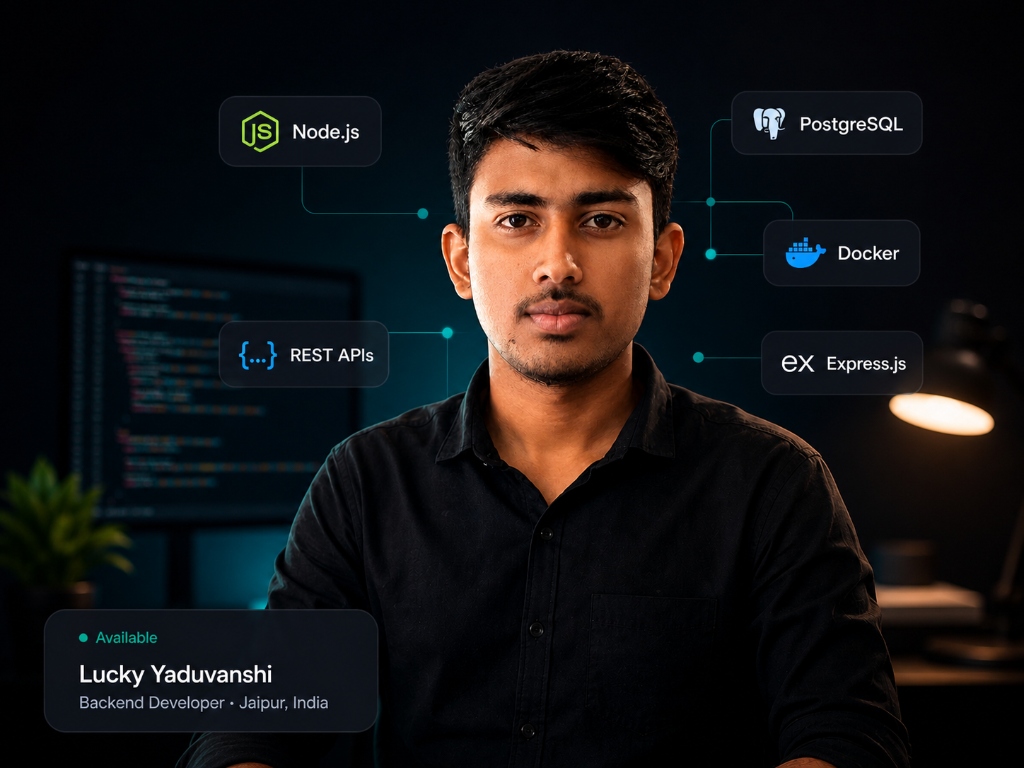
Built and maintained by one developer.
Lucky Yaduvanshi is a backend developer and computer science student who builds high-performance systems with Node.js, PostgreSQL, Docker, and Express — and got tired of AI tooling that only works when the cloud says so.
- Node.js
- PostgreSQL
- Docker
- Express
- REST APIs
Four commitments.
100% offline AI
The assistant runs local models (Qwen2.5, Llama-3.2, DeepSeek-R1-Distill) on your machine. Your code is never transmitted — there is no server to transmit it to.
Zero hardware barriers
Optimized for low-spec machines: 2 GB of RAM is enough, no dedicated GPU, and it runs straight from a portable USB drive.
Always free
Every product costs ₹0 — not free-tier. CodAI’s GPL-3.0 source is public if you want to verify the privacy claims yourself.
Student-first
Lab exams, restricted networks, and shared machines are the primary design target — not an afterthought.
Free, open source, and yours to inspect.